
Medication adherence has long been a cornerstone of pharmacy quality measurement, and for good reason. It's central to how health plan performance is evaluated, directly influencing Medicare Star Ratings and reimbursement. But measuring adherence has never been simple, and for years the field has grappled with a fundamental tension: how do we compare plan performance fairly, when some plans serve populations facing far greater barriers to care? Starting this year, CMS is answering that question with a concrete policy shift. Risk adjustment for adherence Star measures, based on sociodemographic status (SDS) characteristics and developed in partnership with PQA, is now being implemented. It's a change that's been building for some time, and one that requires both a conceptual and operational rethinking of how we approach adherence outreach.
Equality vs. Equity: Why the Distinction Matters
Before getting into the mechanics, it helps to establish a shared foundation. The difference between equality and equity is often illustrated visually: equality is everyone receiving the same thing, regardless of whether it fits their situation; equity is everyone receiving what they actually need to reach the same outcome. In pharmacy, a one-size-fits-all outreach approach — the same refill reminder, the same cadence, the same channel for every member, is equality. But adherence barriers aren't equal. Equity means identifying what's actually getting in the way, cost, transportation, health literacy, caregiver support, and matching the intervention to that barrier.

This distinction matters because adherence gaps are typically about circumstances, not effort. The most effective interventions are needs-matched, and that realization is the conceptual bridge to risk adjustment. If different populations face different barriers then fair measurement and effective outreach both require us to account for that reality without losing accountability.
The Problem Risk Adjustment Is Solving
Health disparities are preventable differences in health outcomes and access tied to unequal distribution of resources, and they are one of the primary reasons adherence performance isn't uniform. These disparities show up across race and ethnicity, income, education, disability status, and geography, and they systematically change the "starting line" for adherence.
In pharmacy quality, these disparities manifest as missed refills shaped by affordability, transportation challenges, health literacy gaps, and competing life priorities. Two health plans with identical clinical protocols may see very different adherence rates simply because they serve different populations, not because one plan is delivering better care.
Risk adjustment addresses this directly. Using statistical modeling, it adjusts expected outcomes based on patient characteristics outside a plan's control, including age, disability status, comorbidities, illness severity, and socioeconomic factors, so that plan performance can be compared more fairly. The goal isn't to lower standards. It's to improve the accuracy of those comparisons.
How the Model Was Built
The PQA Risk Adjustment Advisory Panel (RAAP), working in partnership with CMS, identified which measures were appropriate for SDS risk adjustment and developed the methodology. Their focus was three PDC adherence measures used in Medicare Part D Star Ratings: diabetes, hypertension, and cholesterol, all of which are intermediate outcome measures. Unlike process measures, which are more directly under provider control, intermediate outcome measures are more appropriately adjusted for patient-level factors.
CMS and PQA studied the impact of SDS variables using multivariable logistic regression models at the beneficiary, community, and county level. Variables were only included if they were significantly associated with adherence, existed at the start of care, were outside the plan's control, and could be reliably captured.
The Five Adjustment Factors
The reduced adjustment model accounts for five beneficiary-level characteristics:
- Age
- Gender
- Dual eligibility status
- Low-Income Subsidy (LIS) status
- Disability status
Race was considered but ultimately excluded from the model. RAAP raised concerns about data accuracy, reliability, and the potential for race to be misused as a proxy for socioeconomic status, a meaningful methodological caution.
The logic behind each included factor is straightforward: lower income contributes to higher instability; older age can introduce cognitive or mobility barriers; disability increases care complexity; and population-level adherence differences exist between genders. These are realities that shape the starting conditions for adherence, not reflections of care quality.
The CMS Risk-Adjusted Rate Equation
At its core, risk adjustment compares reality to expectation. The equation CMS uses is:
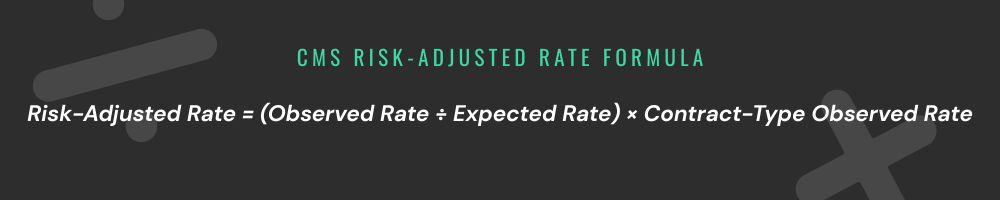
The observed rate is what actually happened: your plan's unadjusted adherence performance, calculated using the historic PDC methodology. This is the component most directly influenced by outreach and care delivery.
The expected rate is a statistically modeled rate reflecting who the plan serves and what adherence performance would be predicted for that population based on member characteristics. CMS will release this rate in August 2027 for calendar year 2026.
The contract-type observed rate serves as a benchmark across all MAPD and PDP contracts.
The ratio between observed and expected rates is critical. If your observed performance exceeds what was expected for your population, your risk-adjusted rate rises relative to the benchmark. If you're underperforming relative to expectation, it drops. Operationally, this means success becomes less about chasing a single raw threshold and more about exceeding what's predicted for your specific member mix.
One important implication: the expected rate is model-based and cannot be directly managed. What plans can manage is the observed rate, through effective, targeted interventions that actually improve adherence outcomes.
It's also worth noting the upcoming weighting changes. In 2026 data (Rating Year 2028), adherence measures are temporarily weighted as single-weighted measures. By 2027 (Rating Year 2029), adherence returns to triple weighting, making accurate risk adjustment even more consequential.
Risk Adjustment vs. Stratification
Risk adjustment and stratification are related but distinct tools, and understanding the difference matters for how you use them operationally.
Stratification breaks a population into meaningful subgroups — dual-eligible vs. non-dual, disabled vs. non-disabled — so performance gaps become visible. It's about segmentation and transparency: showing where disparities exist so you know where to focus.
Risk adjustment produces one overall score that has been statistically corrected for differences in patient complexity and social risk. It levels the playing field for fair comparison across plans.
Together, they work in tandem: stratification surfaces the nuances across subpopulations; risk adjustment ensures the overall comparison is fair. Neither is sufficient alone. Plans need both to understand their performance fully and to make smart decisions about where to direct resources.
What This Means for Outreach Strategy
Risk adjustment and stratification are related but distinct tools, and understanding the difference matters for how you use them operationally.
Stratification breaks a population into meaningful subgroups, such as dual-eligible vs. non-dual or disabled vs. non-disabled, so performance gaps become visible. It's about segmentation and transparency: showing where disparities exist so you know where to focus.
Risk adjustment produces one overall score that has been statistically corrected for differences in patient complexity and social risk. It levels the playing field for fair comparison across plans.
Together, they work in tandem. Stratification surfaces the nuances across subpopulations; risk adjustment ensures the overall comparison is fair. Neither is sufficient alone. Plans need both to understand their performance fully and to make smart decisions about where to direct resources.
Equity-Driven Outreach Questions
- "Have you had trouble affording your medications?"
- "Do you have transportation to get to the pharmacy?"
- "Would mail order be more convenient for you?"
- "Is someone helping you manage your medications?"
Intervention design should follow the risk type. For LIS and dual-eligible members, that might mean copay education, benefit clarification, and community resource connections. For elderly members, medication synchronization, refill reminders, and caregiver engagement. For disabled members, simplified instructions, increased touchpoints, transportation coordination, and behavioral health screening.
Finally, evaluating impact requires looking at outcomes within each stratified group — not just aggregate contact counts. Multiple outreach touchpoints are necessary for sustained improvement, and strategies should be continuously refined based on what's actually moving adherence rates.
The Bigger Picture
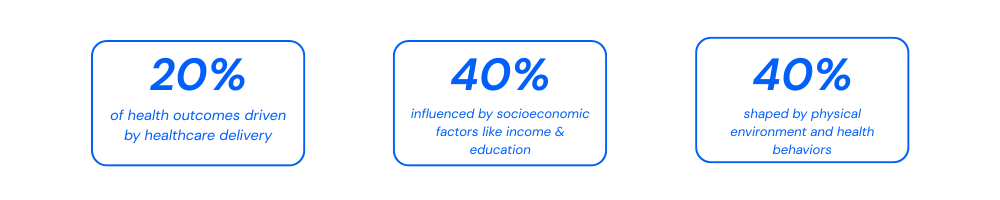
Social determinants of health explain a great deal about why we see the adherence differences we do. Income, transportation access, education, housing stability: these factors shape whether a patient can consistently fill and take their medications, often far more than clinical factors alone. The 80% of health outcomes driven by factors outside the healthcare system isn't an abstraction; it shows up every day in missed refills and lapsed therapies.
Risk adjustment is how measurement catches up to that reality. It ensures plans aren't unfairly penalized for the populations they serve, while still holding everyone accountable for what can be influenced through care delivery and outreach. It doesn't lower the bar; it recalibrates the measuring stick.
But the work itself, identifying high-risk members early, understanding their specific barriers, and tailoring interventions to meet them where they are, remains squarely with us. Risk adjustment explains the differences. Our outreach strategy is what closes the gaps.
At the end of the day, success in this framework isn't just about improving a score. It's about improving outcomes in a way that's equitable, targeted, and sustainable.
-Narega Nazarian, PharmD
Director of Clinical Solutions
Ready to build a risk-adjusted outreach strategy for your members? Let's talk about how MedWatchers can help you close adherence gaps before they cost you stars. Contact us here.